Four to six weeks. You know what happens next at every point, and what it costs.
No hourly billing, no change orders appearing halfway through, no handover that leaves you dependent on us.
- 01
Scope
week 1A call, then a written scope. We work out what the site or tool actually has to do, who it is for, and what would count as it working.
You get a fixed price and a date. Both are on paper before any money moves. If the scope changes later we requote before doing the work, not after.
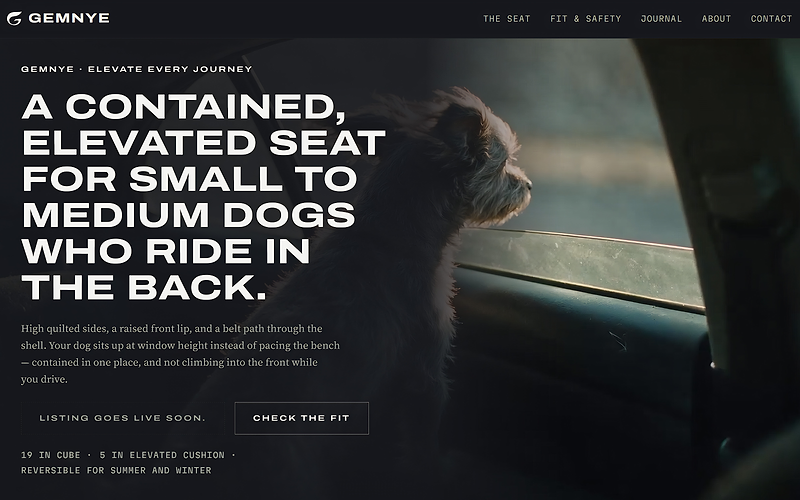
What we need from youwhatever exists already — brand materials, content, access to the systems it has to talk to. If none of that exists, say so. Gemnye sent us one paragraph about their company, and that was enough.
- 02
Design
weeks 1 to 2Tokens and components first, then pages. You see the design system before anything is composed from it, because a wrong decision at that level propagates into everything after.
Two rounds of revision are included and almost always enough.
What we need from youa decision at the end of each round. Not a committee.
- 03
Build
weeks 2 to 5We build against the design system, not against screenshots. Tests are written as we go, not at the end.
You get a staging URL from the first week. Look at it whenever you want.
What we need from youfinal content, if you are supplying it. This is the step that most often slips, and it slips because copy is harder than people expect. We can write it instead.
- 04
Launch
week 4 to 6, plus 30 daysBefore anything goes live: the full test suite, an accessibility audit at seven widths, and a Lighthouse run. We publish the numbers rather than describing them.
Then handover. Repository, hosting, domain, analytics, every account in your name. A written record of how it works and how to change it.
Thirty days of support afterwards, included. Bugs are ours to fix. New features are a new project.
What we need from youNothing. This stage is ours.

- 01
Scope
week 1A call, then a written scope. We work out what the site or tool actually has to do, who it is for, and what would count as it working.
You get a fixed price and a date. Both are on paper before any money moves. If the scope changes later we requote before doing the work, not after.
What we need from youwhatever exists already — brand materials, content, access to the systems it has to talk to. If none of that exists, say so. Gemnye sent us one paragraph about their company, and that was enough.
- 02
Design
weeks 1 to 2Tokens and components first, then pages. You see the design system before anything is composed from it, because a wrong decision at that level propagates into everything after.
Two rounds of revision are included and almost always enough.
What we need from youa decision at the end of each round. Not a committee.
- 03
Build
weeks 2 to 5We build against the design system, not against screenshots. Tests are written as we go, not at the end.
You get a staging URL from the first week. Look at it whenever you want.
What we need from youfinal content, if you are supplying it. This is the step that most often slips, and it slips because copy is harder than people expect. We can write it instead.
- 04
Launch
week 4 to 6, plus 30 daysBefore anything goes live: the full test suite, an accessibility audit at seven widths, and a Lighthouse run. We publish the numbers rather than describing them.
Then handover. Repository, hosting, domain, analytics, every account in your name. A written record of how it works and how to change it.
Thirty days of support afterwards, included. Bugs are ours to fix. New features are a new project.
What we need from youNothing. This stage is ours.
What ships with every build
None of that is an upsell. It is the difference between something that was generated and something that was built.
- A written test suite.
- An accessibility audit against WCAG 2.1 AA.
- A performance budget the site has to pass.
- Documentation.
- Accounts in your name.
Every project starts with a written scope. Ask for yours.
Kordal Systems is a design and engineering studio building websites, web applications and AI-integrated products for e-commerce brands and B2B companies.